

If you hide your work away, no one can criticize it or reject it. Isn’t that clever!? But does that foolproof, protective maneuver really serve you?
The act of writing is not what I find terrifying. What petrifies me is the outcome of showing my writing to other people.
 When I think about writing in a diary, journal, or notebook, the words flow out of me. I find it easiest to write if I
I have always loved to write, but I have never loved sharing it. That fear applies beyond my fiction writing. Until my junior year in college, when it became
On that same fateful day, I got back a paper
To say
Sometimes we need to be criticized .
Not everyone will like the work we produce, and someone might even give it a big fat “F” (metaphorically; don’t we love metaphors in writing?). Although our reaction might be to crawl under a rock, if we can turn that criticism into a productive technique that improves our writing, then is it not worth it?
A safe place to start is with someone who understands your fears and
Once you have “practiced” getting feedback from a safe, critical source, it is time to open yourself to the criticisms of the real world. It will not be easy, but the best way to build up a skin against it is to experience it.
Be discerning about taking in criticism by learning to identify feedback that is meant to be helpful versus what is unconstructive, mean-spirited, or simply invalid.
Unconstructive criticism is something that is purely hurtful. Someone telling you they
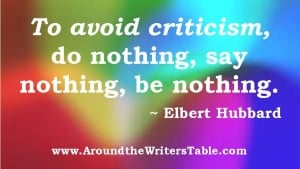 Negative criticism can be helpful even though we
 usually do not want to hear it.
Absorb and process the helpful, honest, and true, and ignore the rest. Or use it as an opportunity to stand firmly by your work, either internally or overtly, depending on your style and personality. Criticism, both “bad” and “good,” will always allow you to grow as a person and an author.
The 97 Best Creativity Tips Ever! (2011), by Dr. Eric Maisel, was the inspiration for this post. Used with permission.
 Bonnie Snow was an intern with Around the Writer’s Table, working toward a graduate certificate in publishing and editing while in her senior year at Florida State University. She

Gina Edwards is a retreat leader, a certified creativity coach, and a book editor. She is also a writer, so she’s intimately familiar with the challenges and elation that come with being one.
She supports all writers—published and aspiring—who want to write as an act of courageous and necessary self-expression.
Walking the writer’s path hand-in-hand with her clients and students, she helps them establish a writing practice and define a creative life on their own terms.
Nicely done.
Any publisher of your work will assign you a professional critic in the form of an editor so it is essential that you learn to accept, but also question criticism. With my editor a critical comment often is the starting place for a discussion about my intent. Usually the intent is not coming through and a rewrite produces something new and better. Once the book is out and no longer malleable, I move on. Books are like children. You do the best you can by them and then let them go, responsible for making their own way in the world.